
Solid GDP Growth in 9M26 Despite Several Headwinds
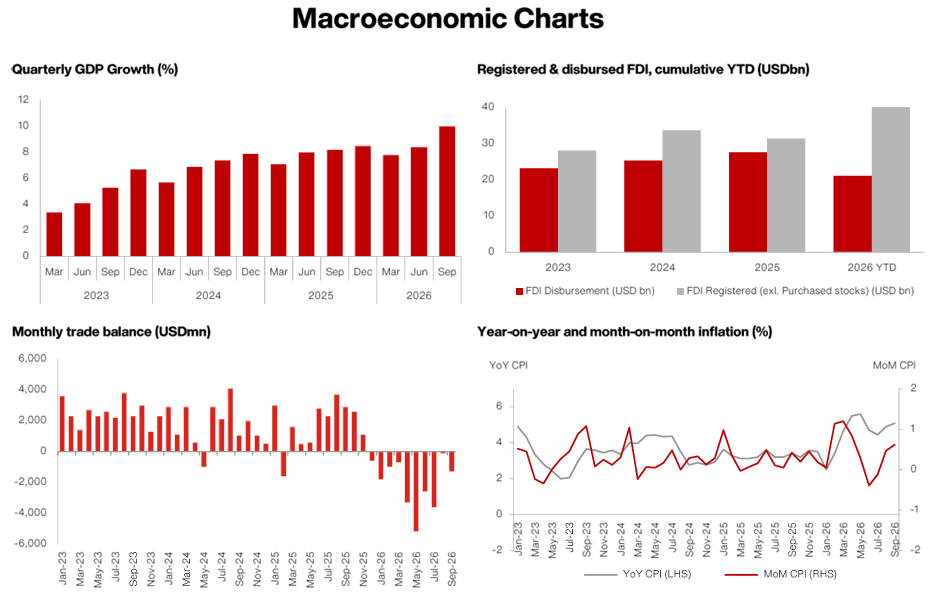
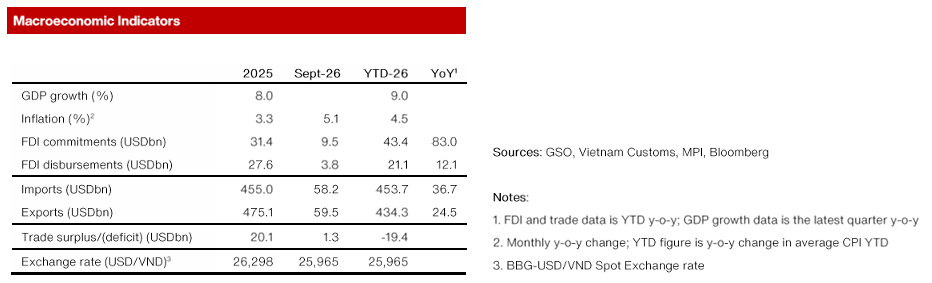
Vietnam’s National Statistics Office (NSO) reported a significant acceleration in the country’s GDP growth, from 8% in 2025 to 9% YoY in 9M26. This increase came despite the US–Iran war, which drove a near-75% year-to-date surge in diesel prices; a jump in Vietnam’s deposit rates, which pushed mortgage rates up to around 13%, and; very poor consumer sentiment over the course of the year. The Government reports that GDP growth accelerated from 7.9% YoY in Q1 to 8.4% in Q2 and 10% growth in Q3.
Two forces are currently boosting Vietnam’s GDP growth. The first is surging high-tech exports, which drove an acceleration in manufacturing output growth to 11.4% YoY in 9M26. Vietnam recorded the world’s largest trade surplus with the US in 9M26 at USD123b billion—equivalent to 31% of Vietnam’s GDP – while electricity consumption is up over 10% this year driven by industrial demand for power.
Surging High-Tech Exports and Infrastructure Spending Drove GDP Growth
The second force is the sharp increase in infrastructure spending, which caused construction activity growth to accelerate to 12.2% in 9M26. Evidence of the surge in infrastructure spending is visible across the country (especially in Hanoi). Construction worker wages have more than doubled this year and construction material prices are up more than 30% YTD, although part of this increase reflects the impact of the war. In short, Vietnam’s infrastructure investment is up nearly 50% YoY and is approaching 6% of GDP (China and Japan spent around 10%/GDP on infrastructure investment during periods of intensive infrastructure development).
Planned FDI – most of which is directed toward manufacturing – is up more than 80% YoY and equates to a stunning 11% of GDP. Samsung’s planned investments include projects that would rank among the most technically sophisticated manufacturing operations ever undertaken in Vietnam.
Early Indications of a Slowdown in Export Growth in the Next Year
These developments suggest that the high-tech export growth story has years to run. But there are also clear signs that the recent rise in high-tech exports, which helped drive a 25% YoY increase in Vietnam’s total exports, will flatten out next year. Specifically, the new export orders sub-index of the Purchasing Managers’ Index (PMI) has turned downward over the past two months and inventories of finished goods of foreign-invested companies are falling sharply.
Taken together, we see these as early indications that these companies anticipate a weakening of their order books. Another, albeit counterintuitive, indication of weakening order books is the recovery of Vietnam’s monthly trade balance from substantial trade deficits that started in December 2025 and continued through August 2026, to a trade surplus of USD1.3 billion in September.
The September surplus is welcome news for the stability of the Vietnamese dong, but it also suggests that high-tech export growth will slow in 2027 because the earlier increase in imports was driven by foreign-invested companies purchasing components to manufacture laptops and other high-tech products. In 9M26, imports grew by 37% YoY, far outstripping 25% export growth. September’s return to a trade surplus suggests that this wave of component imports is now coming to an end, although it also reduced Vietnam’s trade deficit from 7%/GDP earlier this year to 5%/GDP in 9M26.
Vietnamese Dong Appreciated Despite Sizable Trade Deficit
This brings us to the Vietnamese dong, which has appreciated by more than 1% YTD despite Vietnam’s significant 5%/GDP trade deficit this year (trade deficits exceeding 3% of GDP are considered very large). Twelve-month bank deposit rates (unregulated) are up more than 200 bps this year to 8–9%, which has encouraged savers to keep their money in dong. High deposit rates, together with a shift in the errors and omissions component of Vietnam’s balance of payments from negative to positive, help explain the currency’s resilience, in sharp contrast to the experience of regional peers such as Thailand and Indonesia.
High Interest Rates, Petrol Prices, Taxes Weigh on Consumer Sentiment
That said, the jump in interest rates is weighing heavily on consumer sentiment, as is a near-50% YTD increase in retail petrol prices. The Government cushioned the impact of surging global oil prices by cutting environmental and other taxes on petrol and diesel, providing relief equivalent to 15–20% of the price at the pump. CPI inflation reached 5.1% YoY in September (average inflation stands at 4.5%, the Government’s previously stated upper limit), with higher diesel and petrol prices accounting for approximately 3%pts of the headline CPI rate.
Consumer sentiment is also being weighed down by the Government’s crackdown on the informal economy. Many household and cottage businesses that previously paid no tax are being brought into the formal financial system and are now required to pay tax. Alongside higher borrowing costs and petrol prices, this is depressing consumer confidence.
Consumer Spending Accelerated, Despite Weaker Sentiment
The discussion of consumer sentiment leads to a discussion about the divergence between weak consumer confidence and accelerating reported retail sales growth. Various measures suggest that consumer sentiment is near record lows, or at least at its weakest in more than a decade. Yet official figures show that real retail sales growth—the closest proxy for household consumption—accelerated from 6.7% in 2025 to 7.8% YoY in 9M26, despite a slowdown in foreign tourist arrivals growth from 20% in 2025 to 15% in 9M26 (we estimate that foreign tourists account for about 10% of Vietnam’s retail sales).
In our view, the inclusion of previously unrecorded informal economic activity may help explain this apparent contradiction. As household businesses enter the formal economy, some of their activity may be entering the retail sales and GDP statistics for the first time. If this expansion in statistical coverage is captured as growth, it could help explain the reported acceleration in consumption despite the weakness in consumer sentiment.
Finally, in this month’s longer-than-usual economics report, which we have expanded in advance of our annual investor conference, we would like to share some initial thoughts on what to expect in 2027. Before doing so, however, we believe it is useful to recap what we had expected for 2026. In short, we thought that despite the US economy remaining strong, export growth to the US would start to normalize—not decline, just flatten in 2026, coming off an exceptionally high base in 2025.
We Expect a Consumption Recovery, Lower Export Growth in 2027
At the same time, we expected domestic consumption to recover toward pre-COVID levels, as households had been rebuilding savings at an unusually high rate over the last few years. However, export growth to the US has remained very strong this year, while consumption has been held back by high interest rates, the US–Iran conflict, and the crackdown on household and cottage industries that has dented sentiment. Growth has been strong—around our 8% forecast for this year—but the composition was not what we anticipated. Instead of a broad-based “all cylinders” recovery, 2026 in many ways has looked like a replay of 2025, with exports once again doing most of the heavy lifting.
Looking ahead to 2027, we see a meaningful slowdown in the US economy, especially early in the year, which will weigh on Vietnam’s export growth. However, we do not expect tariffs to weigh on that growth as we believe that the risk of new tariff shocks is limited, and it appears likely that the Republicans will lose control of Congress following the mid-term elections next months, which will further reduce the risk of new tariffs.
Infrastructure Spending Surge and Fiscal Stimulus to Support GDP Growth
Given the Government’s very ambitious public growth targets and the likelihood of softer external demand, we think policy support at home will ramp up, leading us to expect 8% GDP growth in 2027. We would not be surprised to see infrastructure spending rise sharply next year, potentially toward 10% of GDP, versus around 6% in the first nine months of 2026. We also would not rule out more proactive steps to bolster household consumption, such as incentives for first-time homebuyers or targeted mortgage-rate subsidies. In short, more fiscal and quasi-fiscal measures are likely to help support domestic demand, in order to offset weaker external demand.