
Michael Kokalari CFA, Chief Economist
The establishment of the Vietnam International Financial Center (“VIFC,” also referred to locally as the “VIFC-HCMC” and/or the “IFC”) has garnered a lot of headlines over the past 18 months. In little over a year, it went from an ambitious concept to establishment and launch in early 2026. Its legal framework was then finalized earlier this month, fueling already-widespread enthusiasm in Vietnam for the highly publicized project, although it is important to note that it will likely take another year for the VIFC to actually become operational.
Not Built to Compete with Dubai
The goal of the VIFC is to make it easier for foreigners to invest in and profit from Vietnam’s economic development. Its establishment was motivated by Vietnam’s estimated USD 1.5T funding gap – money Vietnam needs in the coming years[1] to industrialize the country. In sharp contrast, Dubai’s IFC is a center for wealthy people to park and manage money; its establishment was motivated by the desire to attract high-value economic spill overs associated with the finance industry to Dubai such as highly paid fund management professionals, corporate law firms, and luxury real estate development.
Closing Vietnam’s USD 1.5T Funding Gap
International financial centers serve one (or more) of three functions: 1) facilitating investment abroad for a country’s savers (for example, London facilitated investment out of Europe and into Argentina et al in the early nineteenth century[2]), 2) facilitating inbound capital flows to a country’s companies (i.e., New York attracted foreign capital that financed the construction of railroads and industrial expansion in the US in the late nineteenth century[3]), or 3) acting as an offshore hub for private wealth management (e.g., Switzerland and Singapore). Also, an IFC can be seamlessly embedded within a country’s existing legal system, such as with Singapore, or instead designed as a regulatory carve-out, similar to Dubai’s DIFC[4], where a special set of rules apply within a designated ring-fenced zone.
Echoes of New York, Built for Vietnam
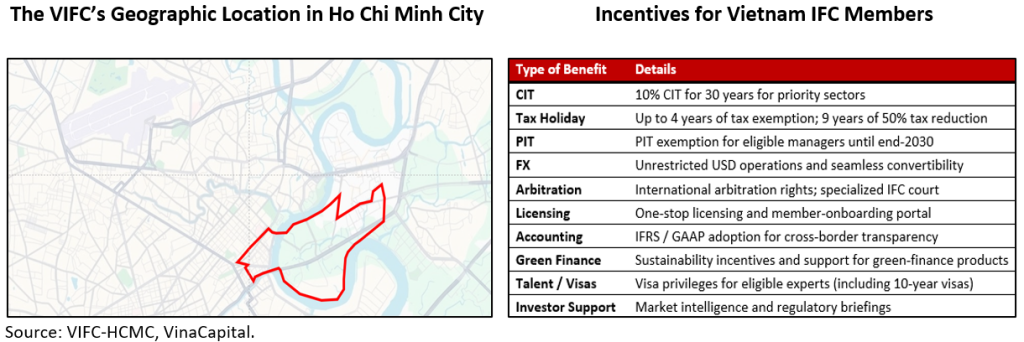
Vietnam’s IFC is economically closer to New York’s during America’s industrialization since it primarily aims to channel foreign capital into infrastructure and other projects. Legally, it is closer to Dubai’s DIFC, since it exists within a ~900 hectares ring-fenced area in Ho Chi Minh City and ~300 hectares in Danang[5] where a special set of laws apply, and within which financial firms operating in the VIFC will enjoy some very attractive benefits outlined in the table above.
Banks First, Then Asset Managers and Bonds
The initial priorities are to establish commercial banks in the VIFC, which will enable foreign capital to seamlessly move in and out of Vietnam, followed by asset management firms that will be able to bypass the current handling of foreign financial assets via offshore entities domiciled in offshore jurisdictions such as Singapore, and corporate bonds to fund projects that require patient, long-term capital (including ESG-linked instruments such as green bonds). Beyond these initial priorities, activities within the VIFC are expected to expand to include commodities trading of rice and coffee, industrial real estate investment trusts (REITs), digital assets, and trade finance products.
Finally, the primary benefit of the IFC for Vietnam will be a lower the cost of capital, while the primary benefit to foreign investors will be a much wider range of financial products that enable participation in the growth of the country’s economy (for example, there are currently no REIT products in Vietnam).
Lessons from Other IFCs
The key lesson for Vietnam from other countries that have established international financial centers is that Vietnam’s IFC should open gradually, starting with a narrow pool of reputable firms while strengthening its executive and supervisory bodies, AML enforcement, and beneficial-ownership transparency. At the same time, Vietnam should pass reforms that increase the ease of doing business outside the IFC since it ultimately interacts with the economy beyond its ring-fenced boundaries.
The establishment of Qatar’s QFC shows how a phased launch coupled with economic reforms implemented over time can translate into wider economic benefits. After initially attracting banks and insurers, the QFC expanded into legal, consulting, and management-office services, and by 2020 activity inside the QFC generated nearly 2% of Qatar’s GDP and supported more than 15,000 jobs[6]. In contrast, Dubai’s DIFC has had some well publicized issues including the 2018 collapse of Abraaj[7], which was headquartered in the DIFC and was once one of the Middle East’s most prominent private-equity firms; that firm collapsed amid a massive fraud investigation, although there were some notable successes including a REIT launched in 2014.
India’s GIFT-IFSC is Vietnam’s IFC Closest Working Peer
India’s GIFT-IFSC – the International Financial Services Centre at Gujarat International Finance Tec-City, which launched in 2015 – is arguably the closest parallel to the VIFC. Like Vietnam, India is a large, fast-growing emerging Asian economy, and GIFT was built as a ring-fenced IFC with the explicit goal of onshoring financial activity that Indian corporates had previously been conducting offshore, and of channeling inbound foreign capital into the domestic economy rather than serving as a parking lot for private wealth in the mold of Dubai or Qatar. That makes GIFT, rather than the Gulf centers, Vietnam’s closest working peer, and because it is roughly a decade ahead of the VIFC on the same road, its successes and stumbles are particularly instructive for Vietnam.
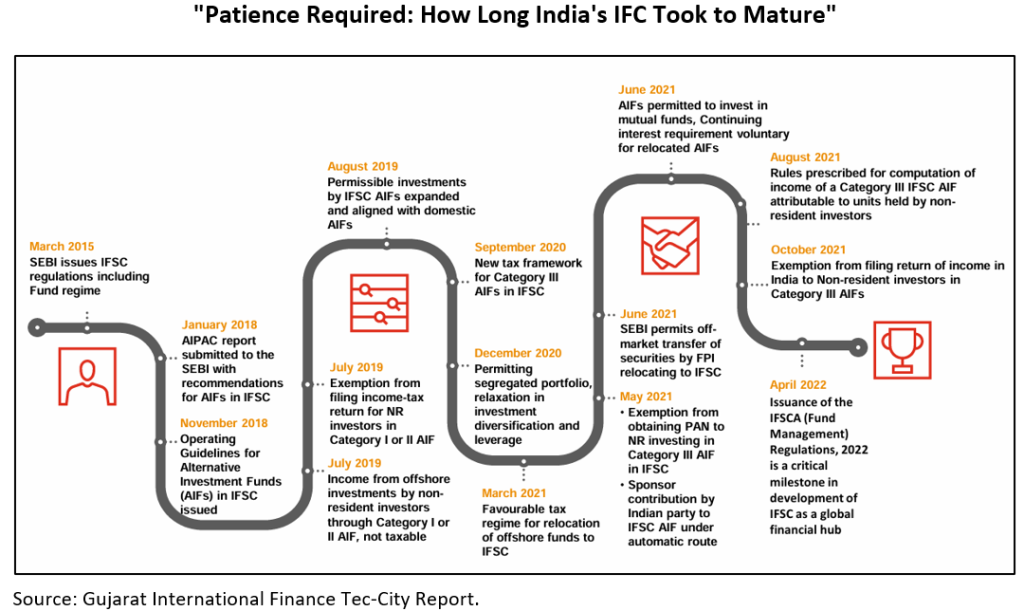
Two key lessons from the GIFT for the VIFC stand out. First, India established a single, unified regulator for GIFT consolidating powers that had been split across four separate domestic regulators; Vietnam’s oversight today remains divided across the SBV, the SSC, and the MoF, so rationalizing regulation for the VIFC from day one would reduce friction. Second, the GIFT’s build-out proceeded product-by-product and took years to gain real traction, as can be seen in the chart above, reinforcing the case for the VIFC’s deliberately phased rollout.
A Coming “Cambrian Explosion” of Financial Products
What’s Next for the VIFC
The Vietnam’s International Financial Center officially launched in February. As noted above, key legal infrastructure components were finalized earlier this month and the IFC’s top priority will be facilitating the entry and exit of funds by licensing commercial banks in the IFC. Once the initial foundational elements are established—particularly banks, fund management companies, and corporate bonds—we expect to see a “Cambrian explosion” of financial products including aviation and maritime finance, green finance, carbon markets, fintech, and digital assets, as can be seen in the chart below from the VIFC-HCMC team.
Trade finance, energy finance, and supply chain finance are natural next steps because they connect directly to Vietnam’s role in global supply chains, although there is also an enormous need to finance infrastructure development in Vietnam. However, to realize all of that potential, the VIFC will need to build on its initial foundations with: 1) clear product-specific regulations, strong supervisory institutions, credible dispute resolution (i.e., English language arbitration similar to the Dubai IFC Arbitration Center); 2) a deeper pool of bankers, fund managers, lawyers, accountants, compliance officers, AML/KYC specialists, regulators, and arbitrators; and 3) growing the supply of bankable projects and credible issuers, with audited financials, transparent disclosure, reliable cash flows, and enforceable contracts.
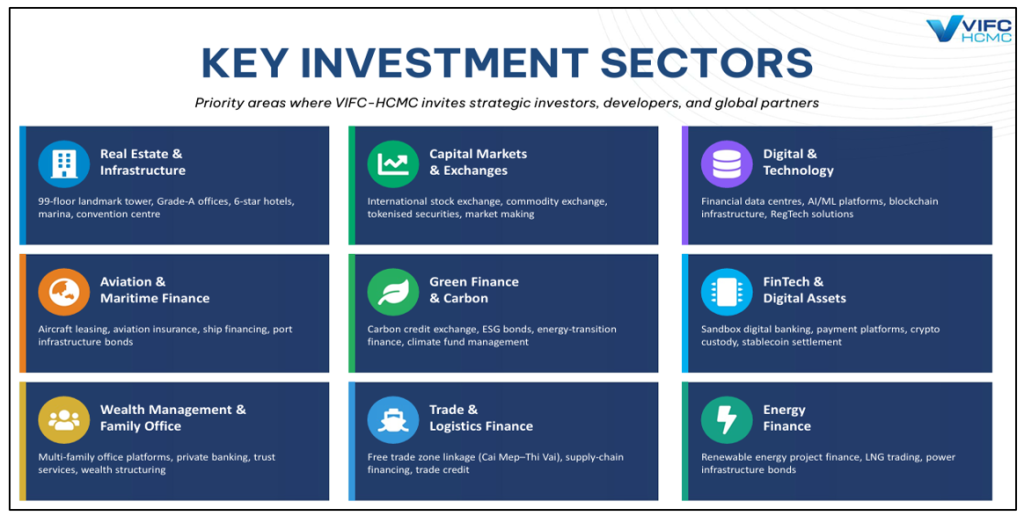
Progress on these fronts will not only strengthen the VIFC but also improve Vietnam’s wider financial system and lower the cost of capital for infrastructure, energy, logistics, housing, and SMEs, as well as enabling the introduction of more financial products and services in the country. Looking ahead, the new VIFC can serve as a controlled policy sandbox for innovations such as tokenized securities, AI-driven compliance tools, and blockchain-based settlement, which—if successfully tested on a limited basis—could later be rolled out across Vietnam’s broader economy.
Vietnam’s Shenzhen-Style Reform Beachhead
In short, the VIFC can serve as a “beachhead” for the proliferation of wider reforms in the broader financial system and broader economy. A comparison to how China leveraged the Shenzhen Special Economic Zone (SEZ) as a beachhead to ultimately implement national reforms is apt. Rather than attempting immediate countrywide change, Deng Xiaoping carved out this small, pragmatic SEZ around Shenzhen, proving the model worked before expanding it nationwide. While the Vietnam International Financial Center is not a SEZ, the analogy stands: it could serve as a similar “beachhead,” enabling the spread of broader financial and economic reforms across the country once they have been proven effective within the IFC.
VIFC to Lower Vietnam’s Cost of Capital and Widen its Range of Financial Products
Finally, VinaCapital is one of the seven founding members of the VIFC and has been working closely with prospective members and foreign investors, as well as with the VIFC’s executive team to help establish investor-friendly guidelines for its future operations. Fortuitously, Vietnam is opening its IFC in a phased manner and offering a wide range of benefits to institutions inside the VIFC, while concurrently implementing major reforms outside the VIFC. Those reforms include expediting the approval of major infrastructure and corporate projects in which VIFC members will soon be able to participate, plus a series of capital market reforms (discussed here) that should deepen liquidity and help lower Vietnam’s cost of capital.
Conclusions
The VIFC is a purpose-built channel for foreign capital to help close Vietnam’s estimated USD 1.5 trillion funding gap to industrialize the country. Although it is legally structured like Dubai’s DIFC, it is not meant to compete with it. Economically, it resembles New York during the US’s industrialization, aiming to finance industry and infrastructure. Success will depend on a deliberately phased rollout beginning with reputable banks and asset managers, the steady build-out of supervisory institutions and professional talent, a credible pipeline of bankable projects, and—critically—parallel reforms in the wider economy beyond the ring-fence.
Managed well, the VIFC can act as a beachhead for broader financial and economic reform, while lowering Vietnam’s cost of capital and widening the range of financial products available to foreign investors. As one of the seven founding members, VinaCapital is working closely with the VIFC executive team and prospective participants and is well positioned to help it realize that potential.
[1] Party General Secretary and State President: Vietnam Needs VND 38 Quadrillion for Its Next Stage of Development, April 2026, VnExpress.
[2] International financial centres an Industrial analysis, September 1990, Bank of England.
[3] The Origins of a Capital Market Union in the United States, April 2018, European Corporate Governance Institute.
[4] Dubai and Abu Dhabi race to lure world’s wealth managers, October 2024, Reuters.
[5] HCMC is expected to function as the VIFC’s main hub, while Danang appears to be being positioned to focus on fintech, carbon credits, innovation startups, and other related initiatives.
[6] The Economic Impact of Qatar Financial Centre in 2020, June 2022, Qatar Financial Center.
[7] Founder of Collapsed Private-Equity Firm Abraaj Fined $135 Million by Dubai Regulator, January 2022, Wall Street Journal.