
High-Tech Exports Drove October’s Record Trade Surplus and Supported the VN Dong’s Value
Vietnam achieved a record monthly trade surplus in October as foreign direct investment (FDI) firms converted previously imported inputs into high-tech exports. But there were clear signs that Vietnam’s export growth is set to flatten out next year, as discussed below.
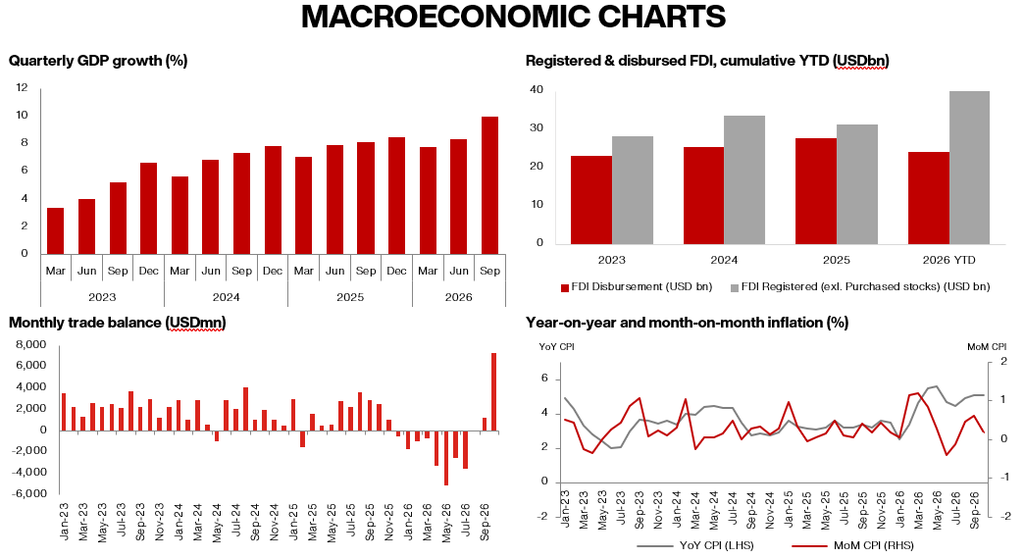
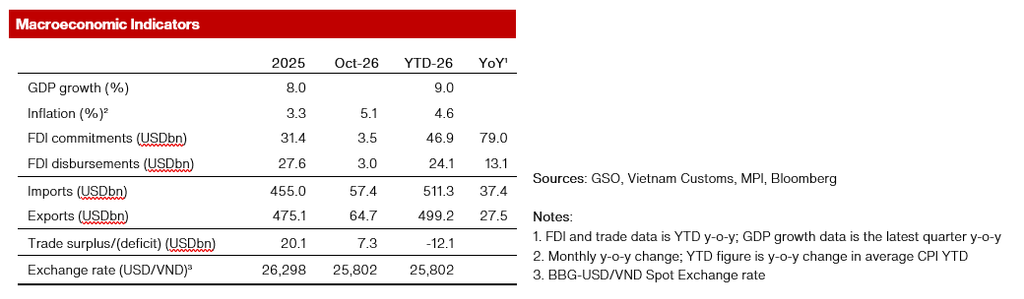
High-tech exports surged by more than 50% year-on-year (YoY) in 10M26, and now account for over 40% of Vietnam’s total exports. This has directly supported manufacturing growth, with YoY growth edging up from 12.9% in 9M26 to 13.0% in 10M26, accounting for nearly 1%pt of the acceleration in Vietnam’s GDP growth this year. The record monthly trade surplus also helped narrow Vietnam’s trade deficit from a peak of 7% of GDP in mid-2026 to a manageable 3% of GDP in 10M26; it also supported the value of the VN Dong, which appreciated by 1.5% since end-September (and by nearly 3% YTD) as of the publication of this report.
The narrowing of the trade deficit links to the caveat noted above: there are clear signs of an imminent flattening in Vietnam’s export growth next year. In mid-2026, FDI companies aggressively purchased production inputs in response to rising export orders, which can be seen clearly in the co-movements of the “New Export Orders” and “Quantity of Purchases” sub-indices of Vietnam’s Purchasing Managers’ Index (PMI), both of which stabilized in April following war-prompted plunges.
Falling New Export Orders and Slower Input Purchases by FDI firms Point to Weaker Export Growth Ahead
Specifically, the New Export Orders sub-index rose from 45.6 in April to a peak of 52.8 in July before falling back to 47.0 in October, indicating that new export orders are now contracting. Similarly, the Quantity of Purchases sub-index climbed from 49.1 in April to 57.3 in July before easing to 54.1 in October. Manufacturers’ input purchases are therefore still expanding, but at a slower pace, in response to shrinking new export orders.
These movements coincided with a sharp swing in Vietnam’s monthly trade balance, which bottomed out at a substantial deficit of USD5.2 billion in May, turned positive with a surplus of USD1.3 billion in September, and then reached a record surplus of USD7.3 billion in October. Production inputs accounted for over 90% of Vietnam’s total imports this year and the monthly trade deficits Vietnam suffered earlier this year were driven by a jump of such inputs by FDI companies.
The gap between monthly import growth (on a YoY basis) and export growth peaked at a whopping 18%pts in June (i.e., import growth was much faster than export growth in June), before flipping back in October (for 10M26, import growth of 37% YoY substantially outpaced 28% export growth). All of the above are clear signs of impending slower export growth and we note that these signs were already apparent before the US midterm elections, which we discussed in this report.
Vietnam’s Long-Term Export Growth Prospects Remain Very Positive
The longer-term outlook for Vietnam’s exports remains extremely positive. Newly registered FDI has risen by more than 70% this year and is equivalent to a stunning 13% of GDP, with most of this registered investment expected to go into industrial production, supporting Vietnam’s export capacity. We discussed the strong long-term prospects for Vietnam’s FDI-driven export growth in an interview with Vietnam’s national broadcaster, VTV, that you can find here.
In addition to surging high-tech exports, infrastructure development is the other big driver of Vietnam’s GDP growth this year. Infrastructure investment has increased 50% YoY in 10M26, equating to 6% of GDP. The Government is reporting continued robust household consumption growth despite high mortgage rates and other headwinds discussed in our investor conference wrap-up report. Specifically, Vietnam’s National Statistics Office reported a significant acceleration in real retail sales growth (i.e., excluding the impact of inflation) from 6.7% in 2025 to 7.7% YoY in 10M26.
Finally, Vietnam’s headline CPI inflation rate remained at 5.1% YoY in both September and October, lifting average CPI inflation to 4.6%. We estimate the US-Iran war contributed 3%pts to Vietnam’s current inflation rate, so a wind-down of that war in the wake of the Democratic Party sweep of the US mid-term elections should significantly lower inflation. Inflation currently stands above the Government’s 4.5% ceiling/target for 2026, prompting electricity price cuts and petrol tax cuts that will lower headline CPI inflation by around 0.5%pts, ceteris paribus.