
Solid GDP Growth in 2Q26 Despite the US-Iran War
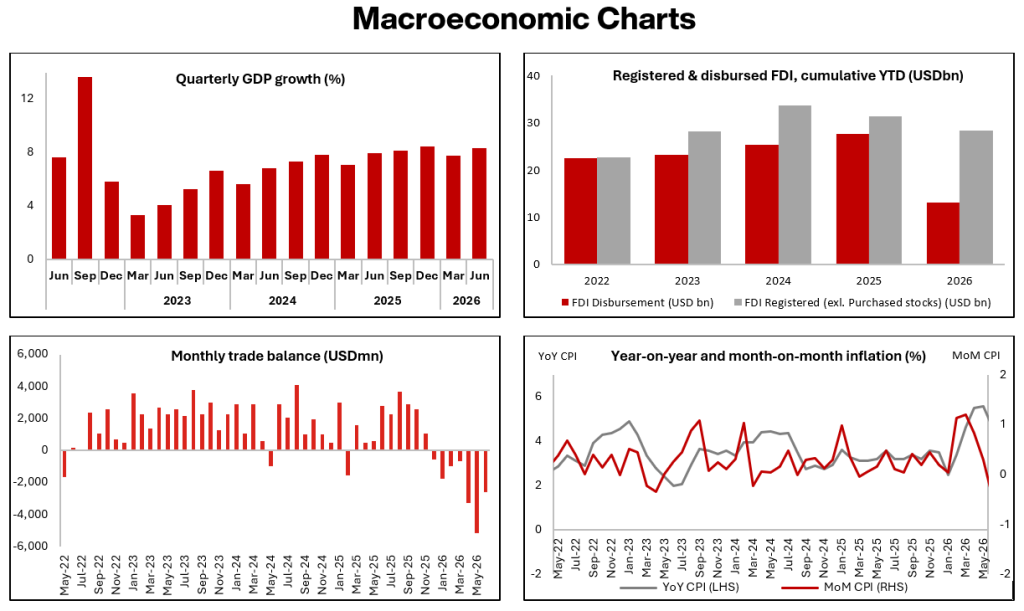
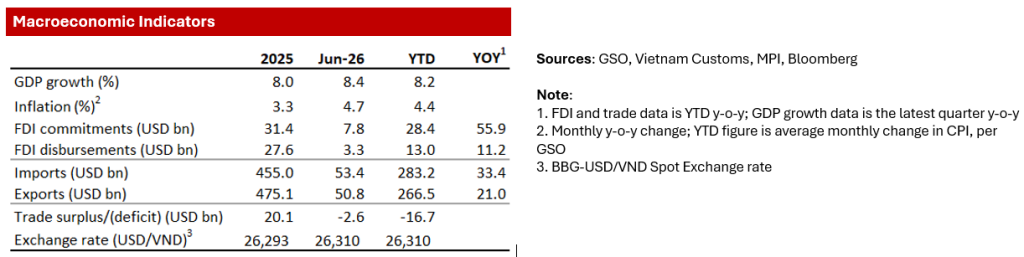
Vietnam’s National Statistics Office (NSO) reported that GDP growth accelerated from 7.9% YoY in 1Q26 to 8.4% in 2Q26 despite the US-Iran war (Vietnam’s GDP grew by 8.2% YoY in 1H26). This acceleration was driven by very strong exports of computer and electronics products, a surge in infrastructure investment, and very surprising consumption resilience from local consumers.
Exports of computer and electronics products were up another 49% YoY in 1H26 after having jumped by 49% in 2025. This stunning performance reflects demand for AI-related products, plus the continued movement of the production of high-tech products from China and other countries to Vietnam. Registered FDI (aka “planned projects”) is up 55.9% YoY, reaching a stunning 11% of GDP, while actual FDI inflows were up 11.2% YoY, reaching 5%/GDP.
Booming High-Tech Exports Drove Growth in Manufacturing
The increase in high-tech exports drove an acceleration in the growth of manufacturing output from 9.9% YoY in 1Q26 to 11.4% in 1H26. That said, Vietnam’s Manufacturing PMI actually dipped from 52.8 in May to 51.8 in June because: 1) new order growth slipped slightly (to be clear, orders are still increasing – but at a slower pace), and 2) employment in the manufacturing sector is shrinking somewhat. That last point may be surprising given all of the above, but part of what is going on is a surge in construction wages is drawing workers out of the factories and onto construction projects.
The Construction Industry is Still Catching Up with the Infrastructure Boom
Infrastructure spending is up 12% YoY in 1H26 after having surged more than 40% in 2025, but the construction industry is having a difficult time absorbing all of the spending, which equated to nearly 7%/GDP in 2025. In addition to the above-mentioned surge in construction worker wages, the construction boom (especially in Hanoi), coupled with the US-Iran war, has pushed construction materials prices up by about 30% this year. All of that said, the growth of construction activity ticked up from 8.5% YoY in 1Q26 to 9.5% in 1H26, and we expect a further acceleration in H2.
Unlike the easily observable acceleration in the manufacturing sector and construction activity, the NSO reported that real retail sales growth accelerated from 7.0% in 1Q26 to 7.3% in 1H26, despite the war – which rocketed retail petrol prices – and despite a marked increase in interest rates this year. Higher rates typically encourage consumers to save rather than spend, while weighing on sentiment by pushing up mortgage costs.
Local Consumption is Resilient, Despite Higher Petrol Prices and Interest Rates
Deposit rates at commercial banks are now up about 150 bps this year to 8-9% on average, and as we have noted in the past, higher deposit rates translate to higher mortgage rates via: 1) high rates on new home purchase loans, and 2) resets of interest rates on existing outstanding mortgages (mortgages in Vietnam are at a floating rate, resetting every two years to rates that are linked to bank deposit rates and are around 13-15% now).
The rise in deposit rates was partly linked to CPI inflation, which hit 5.6% YoY in May before falling to 4.7% in June. Interestingly, the USD-VND exchange rate is nearly unchanged this year despite Vietnam’s 6.6%/GDP trade deficit (which was driven by a surge in imports of components needed to make high-tech exports). In contrast to Indonesia, where the central bank was forced to do two emergency rate hikes to protect its currency, VN Dong depreciation is not a factor in this year’s increase in interest rates.
Interest Rates are Rising on Tight Bank Liquidity, Not on VN Dong Weakness
Instead, interest rates are being pushed higher by a lack of liquidity in the banking system. In 2025, credit growth outstripped deposit growth by 7%pts, pushing the “Simple Loan-to-Deposit Ratio (LDR)” up to circa 110%. This year, credit growth outpaced deposit growth by circa 2.5%pts YTD as of 26 June, so banks are scrambling to raise deposits and Vietnam’s central bank is implementing an increasing range of measures to supply stop-gap liquidity to the market.
Foreign Capital Can Supplement Domestic Liquidity
Higher interest rates should ultimately increase the volume of deposits in the banking system, but foreign capital can also play a role in increasing funds available to fuel the country’s development. We published this report about Vietnam’s new International Financial Center (IFC), which aims to be a conduit for foreign money into the country, and addressed Vietnam’s President and National Assembly, on steps to attract more foreign capital to Vietnam, which was widely reported in the local business press