
Michael Kokalari CFA, Chief Economist
Minimal Expected Economic Impact to Vietnam from Potential US Trade Actions
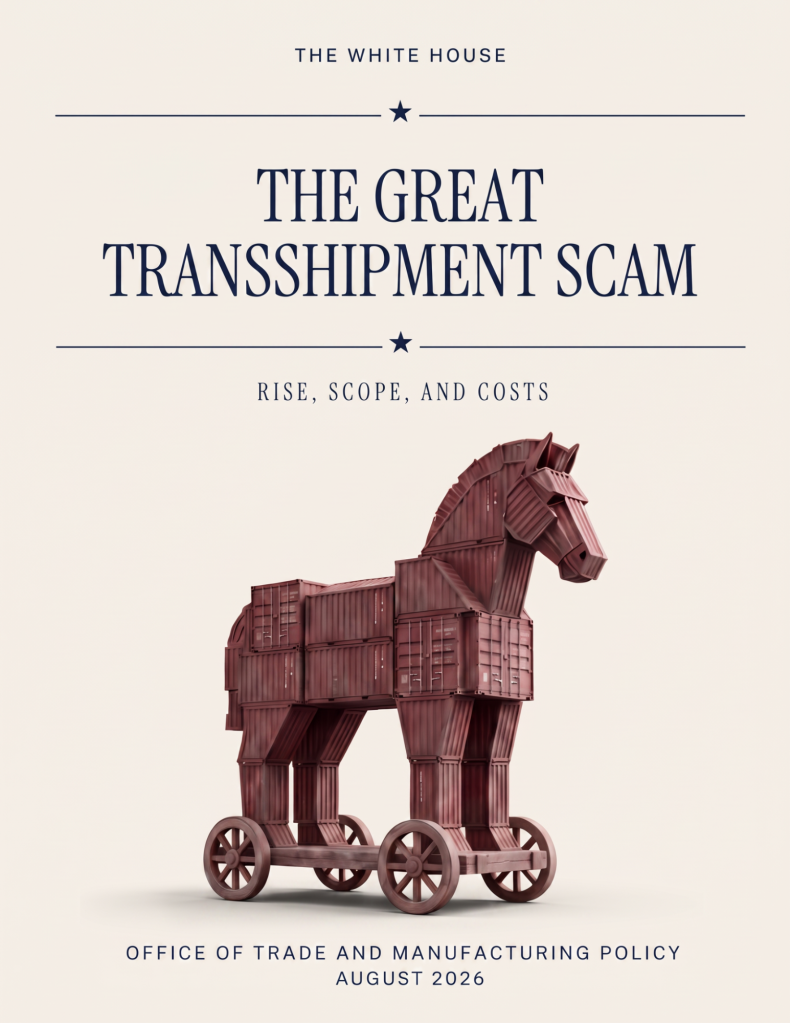
On August 13, the Trump administration published a report titled The Great Transshipment Scam[1], which alleges that China is using a network of more than 40 countries, including Vietnam, to circumvent US tariffs through transshipment. This report follows a flurry of US trade policy actions since the Supreme Court struck down Trump’s “emergency tariffs” on February 20[2]. While our base case is that these actions are unlikely to derail the current key drivers of Vietnam’s economic growth—industrialization fueled by FDI, the emerging middle class, and geopolitical factors—the range of possible outcomes remains unusually wide, and sector-specific disruption could be meaningful if future US actions are broader or more aggressive than currently expected.
Those measures taken by the Trump administration include Section 301 investigations into excess capacity across 16 countries announced in March[3], a broad review of intellectual property protection across more than 100 trading partners announced in April[4], and what became known as “forced-labor tariffs” on approximately 60 economies announced in July[5] — none of which we expect to have a serious meaningful economic impact on Vietnam. That said, the report, which is discussed in an article titled “The White House’s Absurd Claim of a Chinese Transshipment Scam” in Economist Magazine, did have a short-term adverse effect on stock market sentiment, although that quickly subsided in the weeks after
The Latest US Trade Actions Appear Driven by Political Timing
The timing of the latest report’s release also appears deliberate. It comes just weeks ahead of Xi Jinping’s planned US visit in September (China is mentioned nearly 100 times in the report) and it lands amid growing commentary, including on Fox News[6], that the US has come out poorly from the Iran conflict, creating an incentive to shift the political narrative. Additionally, with the US midterm elections approaching, the topics of Chinese tariff evasion and transshipment give the Trump administration a useful way to reinforce his “America First” credentials amid claims it does not actually put America first. That said, political timing does not preclude follow-through: trade enforcement can serve domestic political goals while still producing real tariffs, investigations, or compliance costs for affected exporters.
Given this background, we have outlined a few takeaways regarding our views of the potential impact on Vietnam from recent (and potentially upcoming) developments in US trade policy. Our base case is that the transshipment issue and Section 301 investigations are manageable rather than systemic risks for Vietnam, partly because the vast majority of Vietnam’s exports to the US would likely remain exempt from tariffs in a Section 301 regime. However, the key swing factor is whether future action remains narrow and negotiated, or expands into sectors such as electronics, machinery, furniture, apparel, or other export categories where company-level and sentiment impacts could be more material. Finally, we also discuss some other legal mechanisms that the Trump administration could use in its future global trade policy.
We Are Not Overly Worried About Transshipment Risks for Vietnam
First and foremost, while The Great Transshipment Scam report may sound alarming with its title, the underlying analysis it puts forth is flawed and the facts do not support concerns in Vietnam that a potential transshipment crackdown poses a meaningful economic threat to the country, because:
- If we take the report at face value, the estimated scale of global transshipment is very small (only around 2% of total US imports), meaning at the same time the report aims to present transshipment as a major issue, the data it presents to support that claim highlights that the scale of transshipment is instead marginal.
- The report cannot be taken at face value because the analytical methods used to derive its estimates, including claims that transshipment reduces US GDP by 0.5% and employment by 0.3%, are flawed or overstated (as discussed in more details in the next page).
- Most importantly, Vietnam and the US have aligned interests in stopping genuine illegal transshipment (a crackdown on transshipment aligns with the goals outlined in Vietnam’s Resolution 10 to attract higher-quality FDI and capture more domestic value[7]) and are already actively cooperating on enforcement[8].
Estimates in the Report Suggest a Modest Scale of Transshipment
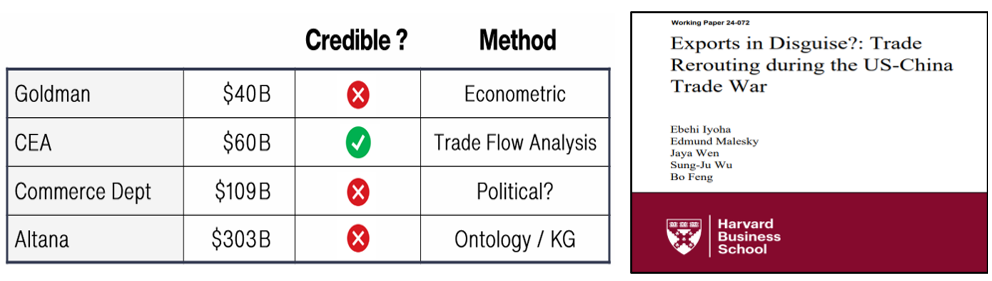
Further to the first point, the report claims that annual illegal transshipment flows into the US could be as low as USD40 billion or as high as USD303 billion. Neither extreme is credible (for reasons discussed below), and the next highest estimate cited is USD109 billion. Total US imports are roughly USD4.5 trillion annually, which puts even the credible high-end figure at just 2% of total imports.
We previously discussed the Harvard University study, Exports in Disguise? Trade Rerouting During the US–China Trade War[9], which estimated Vietnam’s transshipment to the US at under 2% to nearly 20% of exports, or up to ~USD50bn at the high end. That comparison arguably undercuts the White House report’s alarmist tone, since its ~USD109bn estimate for global transshipment appears relatively limited against prior estimates for Vietnam alone.
Transshipment Estimates Vary Widely – and Each Methodology Has Drawbacks
Further to these points, the analytical methods used throughout the White House report are flawed. Goldman Sachs relies on an econometric approach to estimate transshipment, but this methodology is poorly suited to the problem because, similar to the Harvard Business School approach, the estimates can vary dramatically depending on the assumptions used, producing a very wide range of results[10].
On the other extreme, AI supply chain software company Altana does a more granular analysis (in a Palantir-like vein[11]), using an “Ontology” or “Knowledge Graph” approach to trace supply chains down to individual factories and logistics nodes – but effectively, it treats all China-to-Vietnam-to-US flows (for example) as transshipment without accounting for the possibility of any legitimate value added in Vietnam. Chinese inputs processed by Vietnamese factories and workers are not automatically transshipment, so this approach can materially overstate the true scale of illegal trade[12].
Out of the remaining two approaches, the Council of Economic Advisers (CEA) estimate is at least grounded in an analysis of trade flows, and the CEA is generally viewed as a credible advisory body to the US government. By contrast, the Commerce Department reports directly to the White House, and Secretary Howard Lutnick is widely seen as having taken a hardline stance on Vietnam to curry favor with Trump. The method behind Commerce’s USD109 billion estimate is not transparent, and given the political context, it is reasonable to assume that politics played a significant role in shaping that number. For these reasons, the CEA approach is likely the more reliable out of all the methods presented.
Several Conclusions Drawn from the Report’s Estimates are Not Credible
That said, the vast variation in estimates across methodologies shows how difficult it is to estimate the scale of global transshipment. It also calls into question other estimates in the report, such as the claim that tariff evasion costs the US Government ~USD100bn in tax revenues, based on the USD303bn figure above, or the even more outlandish claims that transshipment reduced US GDP by ~0.5% and employment by ~0.3%. Those latter estimates effectively treat trade that shifted from China to countries such as Mexico or Vietnam as new US GDP and job losses, even though those losses would already have occurred when Chinese imports originally displaced US production.
Finally, Vietnam is already taking aggressive steps to crack down on genuine transshipment, including tighter checks on certificates of origin and “Made in Vietnam” labeling for several sectors such as electronics, furniture, and steel[13]. It is also working with the US on enforcement via a joint anti-transshipment and trade-fraud workshop in recent weeks[14].
Section 301: Minimal Impact on Vietnam
Following the Supreme Court’s decision to strike down the Trump administration’s “emergency tariffs”, the White House has increasingly turned to Section 301 of the Trade Act of 1974 to reimpose parts of its previous tariff framework. Section 301 allows the US Trade Representative (USTR) to investigate and respond to foreign acts, policies or practices that are “unreasonable or discriminatory” and “burden or restrict US commerce”[15], but its use requires clearer economic justification and a much more cumbersome legal process, including formal investigations and consultations, making implementation slower, more targeted and more legally contestable than under International Emergency Economic Powers Act (IEEPA) which the Trump administration previously used.
As a result, any new tariffs applied under section 301 are more likely to be sector-specific measures implemented with exemptions, delays, product carve-outs or negotiated settlements, rather than as sweeping country-wide tariffs. For that reason, if additional tariffs are applied, the economic impact on Vietnam is expected to be more concentrated on a handful of sectors, although aggressively targeted tariffs on those sectors could still weigh materially on stock market sentiment.
Over Half of Vietnam’s Exports to the US Could Be Exempt
For Vietnam, there are currently three distinct Section 301 tracks: 1) forced labor, 2) structural excess capacity, and 3) intellectual property. Importantly, only the forced labor case has so far resulted in 12.5% tariffs for Vietnam, a figure that significantly overstates the actual burden. Estimates suggest that over half of Vietnam’s exports to the US are exempt, with the exclusions concentrated in electronics and machinery, Vietnam’s most important export categories.
- Forced Labor. The most advanced case is the forced labor action covering around 60 countries, which has already resulted in a 12.5% tariff on Vietnam. Importantly, the tariff is highly targeted, with major technology products and products already covered by certain Section 232 measures exempted, concentrating the impact on a relatively narrow group of labor-intensive sectors.
- Structural Excess Capacity. USTR also launched an investigation in March covering 16 economies, including Vietnam, which could ultimately result in product-specific tariffs across sectors such as electronics, machinery, footwear, furniture, steel and cement. However, no Vietnam-specific product list or tariff rate has yet been announced, and any eventual action would likely be implemented on a piecemeal basis.
- Intellectual Property. Finally, USTR launched a separate Vietnam-specific investigation in May into intellectual-property protection. Vietnam is the only country targeted with the “Priority Foreign Country” designation, although there is currently no announced tariff, product list or rate, and a determination is not expected until late November.
Further to the second point, even where individual sectors are eventually targeted, we believe the economic impact is likely to remain limited. For example, even if tariffs on furniture increased from 12.5% to around 20%, that would not materially affect Vietnam’s economy (although it would obviously materially impact specific furniture companies that export to the US). That said, any new tariff measures that may emerge will first go through formal trade investigations and interagency review processes, which typically take several months to over a year to complete, and again are likely to be done in a piece-meal manner and with limited scope.
Tariffs are Expected to Come Down Through Negotiations
In addition, VinaCapital’s informal conversations with senior officials in Vietnam lead us to believe that high initial tariff proposals on affected products by the US would likely represent an opening position for negotiation (which is also in line with Trump’s other maximalist positions taken during initial tariff negotiations). Although it is difficult to know how negotiations will play out, some observers believe eventual rates could settle around 20%. At that level, the impact would be meaningful for some companies and could weigh on stock market sentiment but would be unlikely to materially alter Vietnam’s overall economic trajectory.
Section 301 Tariff Impact by Sector: Electronics Exports Largely Exempt
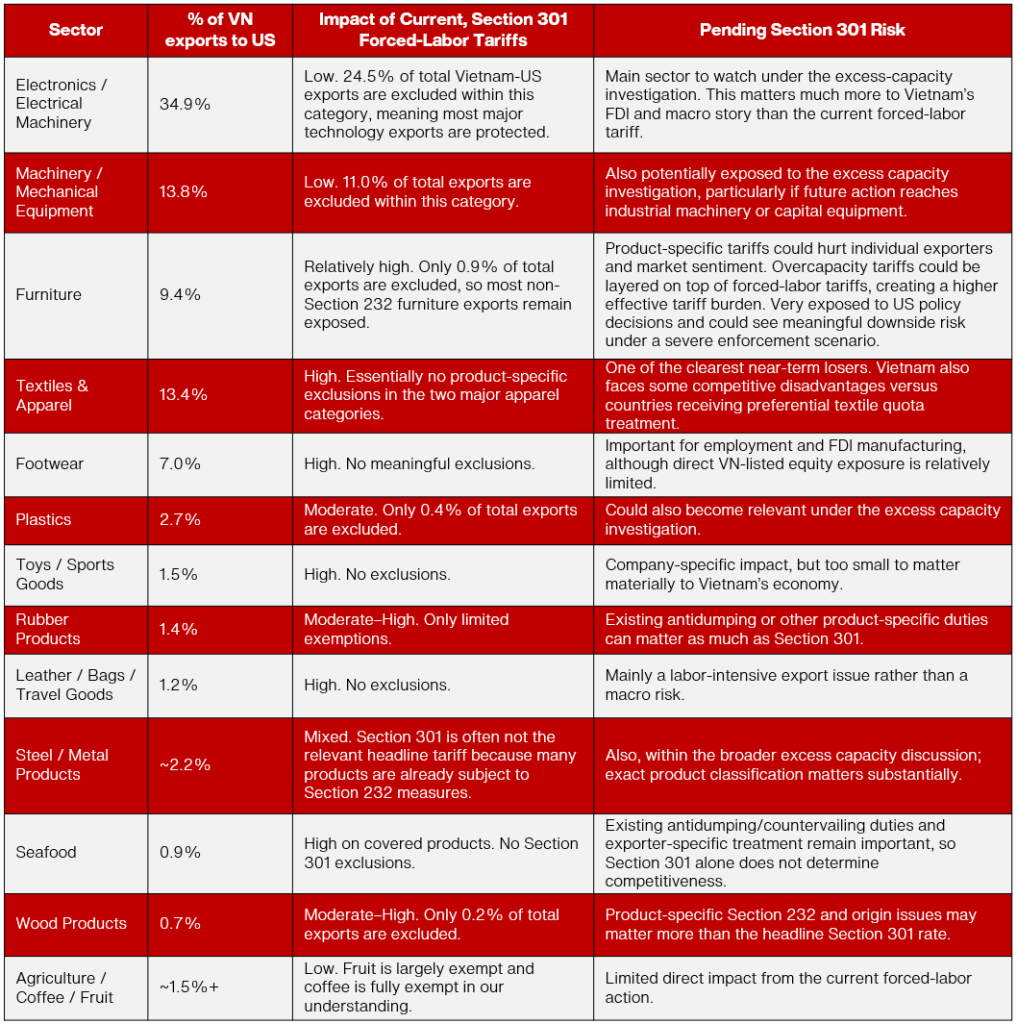
The impact of forced-labor tariffs is highly uneven by sector. The current forced-labor tariff falls mainly on labor-intensive exports, while electronics and machinery are largely protected by exemptions. The more important question for Vietnam’s economy is whether the still-pending excess capacity investigation eventually reaches the high-tech manufacturing complex that drives exports and FDI.
Source: USTR; UN Comtrade; VinaCapital calculations.
Key Sectors May See Short-Term Disruption, But Still Retain Advantages Over China
The current forced-labor tariffs are mainly a problem for textiles, footwear, furniture and other traditional exports, while electronics and machinery are largely protected by exemptions. For Vietnam’s economy, however, the more important issue is whether the pending excess-capacity investigation eventually reaches electronics and high-tech manufacturing, since those sectors are what really matter for the country’s FDI and export growth.
Stock Market Implications
Vietnam’s continued tariff advantage over China should provide modest support to several export-oriented sectors, particularly those where Vietnam has already built large manufacturing capacity and strong trade relationships with the United States. Although the sectors below could see some near-term disruption, they are likely to retain some key advantages over China:
- Textiles & Apparel: Vietnam is one of the largest garment exporters to the US, and lower effective tariffs relative to China should help preserve its competitive position in global supply chains. That said, this high level of exposure makes it vulnerable to potential US trade actions. While some basic apparel production could shift to countries such as Indonesia under new quota arrangements, Vietnam’s listed companies tend to focus on higher-value garments such as technical outerwear, seam-sealed apparel, and premium denim, somewhat mitigating the impact of such moves. Key listed players include garment manufacturers and textile exporters.
- Wood Products & Furniture: Vietnam is one of the largest furniture exporters to the US, benefiting from the ongoing relocation of production away from China. The tariff differential is expected to continue to support Vietnam’s role as a manufacturing hub for global furniture brands, but furniture is also one of the sectors most exposed to product-specific tariffs, rules-of-origin scrutiny, and transshipment-related enforcement. That means the sector can remain structurally well positioned versus China while still facing meaningful near-term earnings and sentiment risk if US measures intensify. Major listed exporters include wood furniture and home furnishing companies.
- Fisheries & Seafood: Vietnam’s seafood exporters are well positioned to maintain market share in the US due to relatively lower tariff exposure compared with Chinese producers. This advantage is particularly relevant for shrimp and pangasius exports, although other categories such as tilapia could be affected; the potential impact is not uniform across the sector. It is possible some products could gain share versus China while others could lose competitiveness against other major exporters such as Ecuador, India, and Indonesia. Key listed companies include seafood exporters.
- Logistics & Ports: Sustained export growth and supply chain diversification should support cargo throughput and logistics activity. Listed port operators and shipping companies could indirectly benefit from continued manufacturing relocation into Vietnam. Key listed companies include port operators and shipping firms.
Overall, the current tariff environment continues to reinforce Vietnam’s role as a major export platform within Asia’s manufacturing supply chain.
Conclusions
The recent flurry of US trade enforcement actions—from the White House transshipment report to expanding Section 301 investigations—is driven far more by domestic US political dynamics and anti-China maneuvering than by an economic mandate to penalize Vietnam. Aggressive rhetoric and forced-labor tariffs from the US create headline noise that can potentially weigh on stock market sentiment and cause short-term disruption for specific labor-intensive sectors like garments and furniture, although those sectors should maintain a significant structural tariff advantage over China. Furthermore, we believe well over half of Vietnam’s total exports to the US would likely remain shielded by product exemptions, with vital electronics and high-tech manufacturing largely insulated under the current framework.
History and recent regional precedents show that US trade pressure routinely transitions from maximalist threats to negotiated settlements and tariff-rate quotas. However, the erratic nature of the current US administration, facing significant political headwinds at home and globally, creates a high level of uncertainty regarding possible outcomes such as the timing of investigations, tariff rates, product exemptions, enforcement intensity, and the risk that negotiations take longer than expected.
All of that said, with Vietnam actively engaging with the US and enforcing origin labelling and other measures, we believe the country’s role as a primary beneficiary of global supply chain diversification remains intact. The most likely outcome is still limited macroeconomic risk, but that view is predicated on future US action remaining targeted and negotiated versus expanding into strategically important export sectors.
[1] The Great Transshipment Scam, The White House, August 2026.
[2] US Supreme Court strikes down Trump’s global tariffs, Reuters, February 2026..
[3] US launches unfair-trade probes to rebuild Trump’s tariff pressure, Reuters, March 2026.
[4] USTR Releases 2026 Special 301 Report on Intellectual Property Protection and Enforcement, USTR, April 2026.
[5] Trump to impose ‘forced labor’ duties on Friday as temporary 10% US tariffs expire, Reuters, July 2026.
[6] Winning the battles, losing the war? America must define the endgame in Iran, Fox News, March 2026.
[7] Viet Nam charts new course for FDI attraction, Vietnam Government News, June 2026.
[8] Vietnam, US step up cooperation against illegal transshipment, trade fraud, Reuters, July 2026.
[9] Exports in Disguise? Trade Rerouting During the US–China Trade War, Harvard Business School, September 2025.
[10] See Stanford Professors Susan Athey and Guido Imbens, “A Measure of Robustness to Misspecification,” American Economic Review, May 2015. The authors show that one way to test how robust a model is involves checking how much the results change under different model specifications.
[11] See Ontology System, under Palantir’s website, for more details.
[12] See “The White House’s absurd claim of a Chinese transshipment ‘scam’,” The Economist, August 18, 2026. The article notes that US trade rules traditionally distinguish legitimate manufacturing through the concept of “substantial transformation,” and argues that the White House report adopts an exceptionally broad definition of transshipment by treating Chinese inputs, suppliers or ownership as evidence of circumvention.
[13] Vietnam clamps down on fraud on US exports, document shows, Reuters, April 2025.
[14] Vietnam plans new penalties for illegal transshipments after Trump deal, documents show, Reuters, July 2026.
[15] Section 301 of the Trade Act of 1974, United States Congress.