
Vietnam is embarking on sweeping reforms across both the public and private sectors that some are calling “Doi Moi 2.0.” These initiatives aim to boost the country’s GDP growth potential by increasing the (already highly significant) role of the private sector in the economy, streamlining the Government’s own operations, and addressing other sources of inefficiency in the economy. The first signs that these reforms are working are already emerging: there has been an impressive 40% surge in infrastructure spending in H1 (according to the Ministry of Finance), which in turn reflects progress on streamlining the approval processes that impeded spending in recent years. Vietnam’s infrastructure spending actually declined in 2024, as can be seen in the chart below, despite a dire need for increased investment in this rapidly industrializing country.
The Q2 spending rise that can also be seen below was driven both by a heightened sense of urgency across Government agencies and newly expanded authority for local governments to fast-track and execute major projects. Specifically, spending is increasing at the local level, where disbursement is up by more than 40% YoY. Several provinces in Vietnam are undergoing mergers as part of the broader, sweeping reforms across both the public sector and (which we discussed in this report) and in the private sector (see this report). Provincial mergers, plus other internal Government initiatives, have promoted a sense of urgency among both local and central Government officials, which is one factor prompting local authorities to fast-track project approvals – especially those that are “shovel ready,” such as expanding existing roads/highways.

In addition to increased urgency, recent legal reforms are essentially delegating a lot more authority in public projects to the local level. The National Assembly recently approved a series of measures that enable local authorities to approve major projects (e.g., airports and urban area developments larger than 50ha) that previously required Prime Minister-level approval. In addition, the approvals process for local and national public projects is being streamlined and the Government is actively encouraging more Public Private Partnerships (PPP), including both a resumption of Build-Transfer (BT) projects, which had been stalled for the last few years, and a potential widening of the definition of “PPP” projects to well beyond roads, bridges, and tunnels to potentially include data centers and other components of “high tech infrastructure.”
For example, the merger of 63 province-level treasury offices into 20 regional offices cut the number of required interactions between contractors and state treasuries by about half and contractors are now able to submit documents online to regional State Treasury offices. The net result is a dramatic drop in the time it takes for financial disbursements to reach contractors – to just 1-3 days – much faster than the previous process, which required multiple in-person interactions and an abundant amount of manual paperwork.
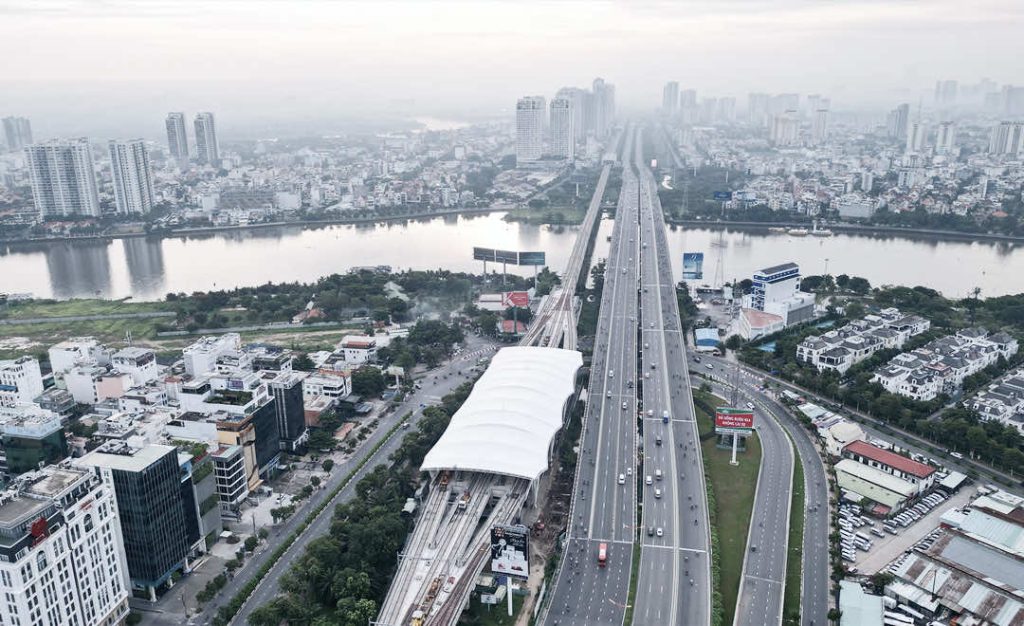
In short, the confluence of provincial mergers, regulatory relaxation, and an overall heighted focus on economic growth in the Government is helping to drive this increase in infrastructure spending, which is seen as a key driver of GDP growth. Finally, progress on larger scale national projects is also accelerating, and the completion timelines on several major projects such as the USD 13B Long Thanh Airport, USD 13B Hanoi and HCMC Ring Roads, and USD 8.4B Lao Cai–Hanoi–Haiphong railway has been shortened by as much as three years.
Legal Framework Updates
Vietnam’s Government is working on modifying several laws related to infrastructure investments with the aim of increasing private sector involvement in projects that are aligned with national infrastructure objectives and to further streamline the disbursement of public funds. Some key legal developments are listed in the table below.

Vietnam is well-positioned to sustain its strong momentum in disbursements of infrastructure investments; Government debt is below 40% of GDP, the budget surplus was over 5%/GDP in 5M2025, and it has over USD 45bn in undisbursed funds earmarked for infrastructure spending. The primary impediment to faster infrastructure disbursement in the past has been legal and regulatory bottlenecks, which the measures listed above will help alleviate.
Beneficiaries of Infrastructure Spending
Despite higher infrastructure investment in Vietnam, investment options in listed infrastructure-related stocks in Vietnam remain somewhat limited, although some “second derivative” stock plays such as construction materials firms can give investors good indirect exposure to the nascent boom. Many of the key contractors and materials suppliers that are benefiting from increased infrastructure investments in Vietnam are private firms, such as Son Hai and Truong Son; some of the publicly listed infrastructure firms suffer from unsophisticated corporate governance or financial management.
That said, certain firms like Vietnam’s leading steel producer Hoa Phat Group (HPG) have good corporate governance, stronger management teams, and healthier cash flows. HPG has substantial production capacity, its growth is closely linked to Vietnam’s infrastructure development, and the company is expanding its capabilities into producing the steel required to build high-speed railway rails, given the Vietnamese Government’s Resolution 172. The table below highlights various listed infrastructure companies categorized by the sub-segments of infrastructure development that they specialize in.

Conclusion
Vietnam’s infrastructure spending surged 40% YoY in 1H25 fuelled by: 1) fast-tracked approvals of projects amid provincial mergers; 2) legal reforms granting provinces more decision-making authority over project approvals; and 3) the streamlining of disbursement processes. Going forward, the Government is revamping many investment laws to boost private investment, relaxing PPP and BOT conditions, increasing state contributions, and expanding eligible project types.