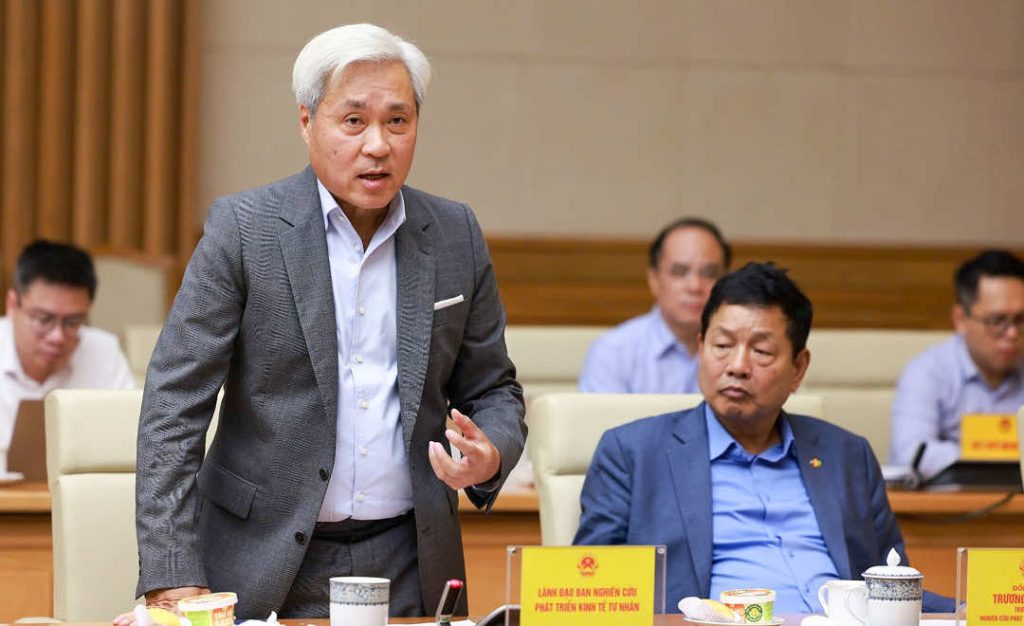

This past Sunday, Prime Minister Pham Minh Chinh convened a meeting of the Private Sector Development Committee (Committee IV) to discuss ways to assist the growth of private enterprises in Vietnam, as part of the implementation of Resolution 68, which puts the private sector as the driver of economic growth in the years ahead.
Deputy Prime Minister Nguyen Hoa Binh, Deputy Prime Minister Nguyen Chi Dung, leaders of Ministries, and members of the Prime Minister’s Policy Advisory Council were also in attendance. Don Lam, CEO and Founding Partner of VinaCapital and Vice Chairman of Committee IV, discussed ways to mobilize capital for the private economy to grow. He stated that there should be a shift toward attracting domestic capital instead of relying on foreign capital, with voluntary pension funds, insurance funds, and infrastructure funds driving this shift.
He also highlighted the need to promote IPOs (including equitizations) and to increase the quality of listed companies, stating, “Promoting public enterprises in both quantity and quality is a strategic solution to develop the capital market in depth, gradually forming a transparent, efficient, and internationally integrated financial ecosystem.”

Don further noted how fintech can be leveraged to support the growth of small and medium-sized businesses that often do not meet the lending requirements of traditional banks. Finally, he detailed the need to develop private economic metrics based on international standards to better compare the development of Vietnam’s private economy as well as measure the implementation of Resolution 68.
The Prime Minister directed the Committee to continue its advocacy for private sector development as well as work to establish a development fund that will focus on investing in medium-sized companies and help them grow, with the aim of creating more home-grown leading businesses across more sectors. Don agreed to lead Committee IV’s efforts on this front, vowing to work and coordinate with the relevant authorities to align with their future policies.