Vietnam Macroeconomic Commentary: February 2026

Continued Weak Consumption, Strong Manufacturing

The economy has started 2026 on an unexpected trajectoryIn the first two months of 2026, Vietnam’s manufacturing output significantly accelerated, but consumer spending softened, which is the opposite of the trajectory we had expected for the year. In 2025, Vietnam’s economy was driven by a surge in exports of high-tech products to the U.S., which boosted manufacturing output, and by a rise in tourist arrivals—especially from China. Consumption by local consumers was lukewarm last year, and we had expected a continuation of those conditions in the first half, followed by a pickup in the second half as consumers rebuild their savings buffers, post-COVID.

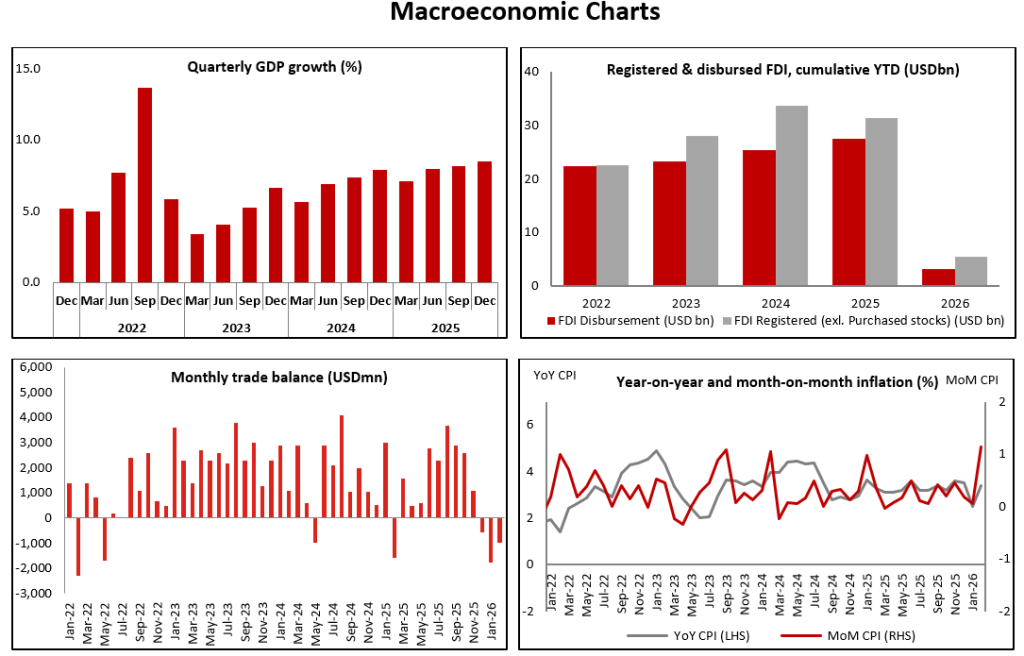
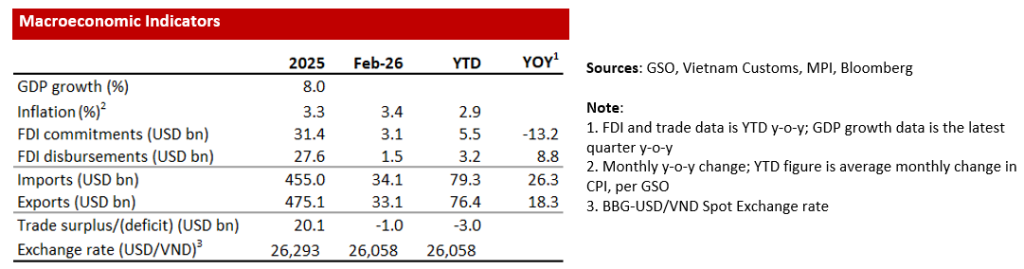
Manufacturing accelerates, tourism growth moderatesWe also expected “soft landings” for both the manufacturing and tourism sectors. Instead, manufacturing accelerated from 10.5% growth in 2025, to 11.5% yoy in 2M26, pushing Vietnam’s manufacturing PMI up from 52.5 in January, to 54.3 in February while Retail Sales growth fell from 9.2% in 2025, to 7.8% yoy in 2M26 – although the deceleration in tourism arrival growth is playing out in line with our expectations, decelerating from 21% to 18%.

Continued strong exports to the USInsatiable demand by U.S. consumers for high tech products that are made in Vietnam has delayed the soft-landing scenario, which we still expect later this year. Vietnam’s exports to the US and exports of computers and other electronics products grew by 22% and 41% respectively in 2M26.  Furthermore, imports of production materials by FDI companies soared – which is a strong leading indicator (total imports surged 26% yoy in 2M26, versus 18% export growth). However, new export orders have flattened out, and the US-Iran war should dampen US demand for Vietnam’s exports somewhat – although our base case for the war will end up being a short, sharp conflict, which we discussed in this report.

Higher interest rates weighing on consumptionBank deposit rates in Vietnam increased by about 1%pts last year (to 6% for 12-month deposit rates), and that increase is starting to filter into resettable mortgage interest rates (mortgages in Vietnam are floating rate and typically reset every two years). Rates on many mortgages are now resetting from ~10% to ~13%, which is one factor dampening consumer sentiment and spending. Notably, some articles have already highlighted weaker spending during this year’s Tet holiday.

What will the Government do?  Vietnam’s Government has a 10% GDP growth target for 2026, including a 9% target for Q1. Consumption is over 60% of GDP and manufacturing is 25%, so the dip in retail sales growth from 9.2% to 7.8% is only partly offset by the acceleration in manufacturing output growth from 10.5% to 11.5%, which implies GDP growth slipping from 7% in 1Q25, to about 6.5% in 1Q26. This weak performance, coupled with the negative impact of the US-Iran war (which is likely to knock at least 0.5%pts off 2026 GDP growth) means that the Government will need to take decisive actions in order to achieve an acceptable level of economic growth.

Limited options to boost growthComing into this year, the State Bank of Vietnam signaled its intention to tighten credit growth limits in 2026 – partly to protect the value of the VN Dong. Those measures worked. The USD-VND exchange rate has barely moved this year, despite a circa 5% increase in the US Dollar/DXY Index, in the lead-up to the war. The surge in oil prices means that inflation in Vietnam will likely spike from 3.4% yoy in February to over 5% in March and April, before dropping alongside oil prices once the war ends, which will impede the Government’s ability to support GDP growth by cutting rates. The Government could also double down on infrastructure spending but spending already surged by more than 40% last year, and physical limitations impede how quickly additional spending could flow into the economy.

Measures to support consumptionGiven all the above, we believe that the only realistic way for the Government to boost GDP growth is by taking aggressive measures to boost consumption and/or the real estate market. Last year, the Government took actions to boost consumer sentiment and spending, including a modest personal income tax break, a slight VAT reduction, and severance payments to laid-off civil servants, but given that cutting interest rates aggressively amid increasing inflation is not realistic, the most obvious path forward would be for the Government to pursue more aggressive measures to stimulate consumption, potentially, including support tied to the housing sector (this is just our speculation on what could be done, but any effective measures to support the economy would likely target real estate and consumption support).
latest insights

Article

Priced for Crisis, Primed for Growth: Vietnam’s Bifurcated Stock Market

VOF Podcast

Podcast

Monthly Podcast – April 2026

Macro Report

Vietnam Macroeconomic Commentary: April 2026

Receive Updates:

red-right-arrow

Video Updates

red-right-arrow

Macro Reports

red-right-arrow

Latest News

red-right-arrow

Insights

IMPORTANT NOTICE

ACCESS TO THIS WEBSITE MAY BE RESTRICTED UNDER SECURITIES LAWS OR REGULATIONS IN CERTAIN JURISDICTIONS. THIS NOTICE REQUIRES YOU TO CONFIRM CERTAIN MATTERS (INCLUDING THAT YOU ARE NOT RESIDENT IN SUCH A JURISDICTION) BEFORE YOU MAY OBTAIN ACCESS TO THE WEBSITE.

This website has been prepared for use solely by individuals who are resident in the United Kingdom for tax and investment purposes. The information contained in this website is not for release, publication, or distribution, directly or indirectly, in whole or in part, to US persons (as defined in Regulation S under the US Securities Act of 1933) (“US Persons”) or into or within the United States (including its territories and possessions, any state of the United States and the District of Columbia), Australia, Canada, the European Economic Area, Japan, the Republic of South Africa or any other jurisdiction where to do so would constitute a violation of the relevant laws or regulations of such jurisdiction (each a “Restricted Jurisdiction”).

Viewing this website and the information contained herein may not be lawful if you are resident or located in a Restricted Jurisdiction. In certain jurisdictions, including the Restricted Jurisdictions, only certain categories of person may be allowed to view such materials. Any person resident or located outside the United Kingdom who wishes to view this website and the information herein must first satisfy themselves that they are not subject to any local requirements that prohibit or restrict them from doing so.
If you are not resident or located in a Restricted Jurisdiction, you may access the website and the information contained herein but you are responsible for first satisfying yourself as to the full observance of the laws and regulatory requirements of your jurisdiction. If you are in any doubt, you should not continue to seek to access.

This website and the information contained herein is not being, and must not be, copied, forwarded, transmitted or otherwise distributed or sent to any US Person or in or into any Restricted Jurisdiction and persons receiving such information must not copy, forward, transmit or otherwise distribute or send it to any US Person or in or into any Restricted Jurisdiction.

If you are not permitted to view this website or are in any doubt as to whether you are permitted to do so, please exit the website and seek independent advice. We do not assume any responsibility for any violation by any person of any of these restrictions.

INVESTMENT RISKS

Past performance is not a reliable indicator of future results. The value of shares and the income from them can go down as well as up as a result of market and currency fluctuations and investors may not get back the amount they originally invested. Investment in unlisted securities is likely to carry more risks than investment in listed securities. An investment in VinaCapital Vietnam Opportunity Fund entails risks which are described in the most recent annual report and Key Information Document, both of which are available on this website.

WEBSITE TERMS OF USE

By using this website you confirm that you have read, understood, and accepted the terms and conditions contained in this disclaimer. These terms of use may change at any time. Any changes will be posted on the relevant page of this website and you should check regularly to see any changes or updates to the terms of use. Your access to this website is governed by the version of terms of use then in force.

CONFIRMATION OF UNDERSTANDING AND ACCEPTANCE

By clicking “I UNDERSTAND AND AGREE” and entering the website, you represent, warrant and agree that you: (1) have read and understood this notice, and will read this disclaimer in full ; (2) agree to be bound by its terms (and acknowledge that the Company and its affiliates, subsidiaries, directors and advisers may rely on your agreement); (3) are a resident of the United Kingdom or another jurisdiction into which the distribution of the information contained in this website does not constitute a violation of the relevant laws of such jurisdiction; (4) are not a US Person or a resident of or located in any Restricted Jurisdiction and are permitted under relevant laws to receive the information contained in this website; and (5) agree that you will not copy, forward, transmit or otherwise distribute or send any information contained in this website to any US Person, to any person who is resident or located in a Restricted Jurisdiction or to any publication with a general circulation in Restricted Jurisdiction. If you are not able to so represent, warrant and agree, you must click “I DECLINE” or otherwise exit this website.