
Continued Growth Momentum, Despite High Interest Rates, Record-High Trade Deficit
AI Exports Continued to Drive Manufacturing and GDP Growth
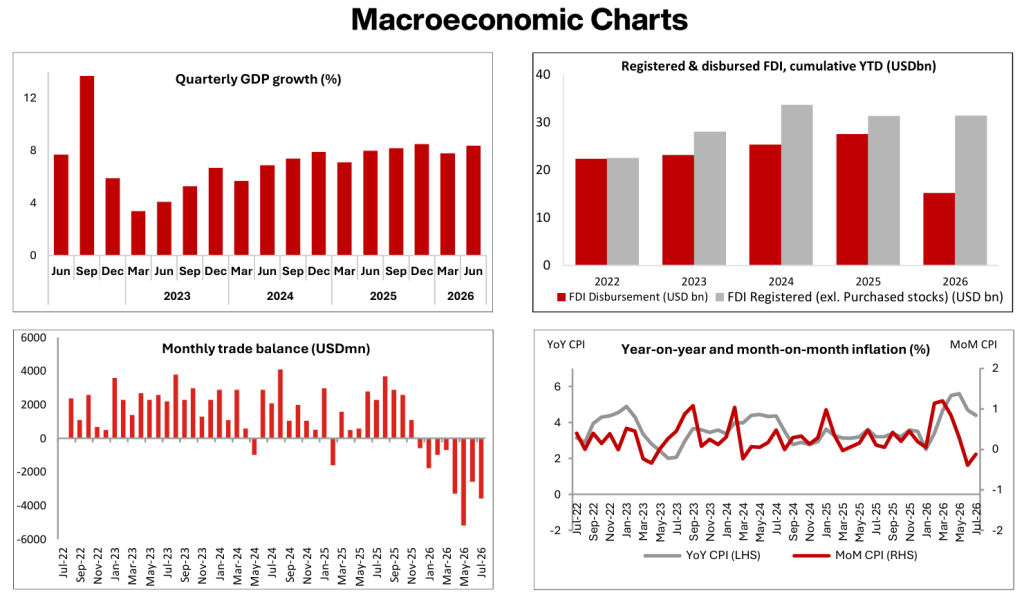
The global AI boom continues to provide a powerful tailwind for Vietnam’s high-tech exports and GDP
growth. Exports of computers and electronic products surged 50% year-on-year (YoY) in 7M26, following a
near 50% increase during 2025. Overall, tech exports grew 39% YoY in 7M26 and accounted for nearly 40%
of Vietnam’s total exports. Historically, Vietnam’s tech exports have been split roughly evenly between
smartphones and computers/electronics, but over the past two years, virtually all of the growth has come
from computers and electronics, driven by the AI investment boom, while smartphone exports remained
broadly flat amid a lack of major new product launches.
That pattern shifted with the recent release of the Samsung Galaxy Z Smartphone Series, which triggered a
sharp rebound in smartphone-related shipments. The net result of all of the above is that growth in the
manufacturing sector, which accounts for one-quarter of Vietnam’s GDP, accelerated from 11.4 % YoY in
6M26 to 12% growth in 7M26 (note that manufacturing growth averaged 12%, pre-COVID). Furthermore,
Vietnam’s Purchasing Managers’ Index picked up from 51.8 in June to 52.9 in July, which was the 13th
consecutive month that the PMI stayed above the 50 expansion–contraction threshold.
Critically, several leading indicators have turned decisively positive. The “New Export Orders” PMI sub-index,
which had bottomed out at 45.3 in March, rebounded to 51 in June, crossing back above the expansion
threshold, and then strengthened further to 52.8 in July, clear indications that order books are again filling.
Consequently, purchases of production inputs jumped to a four-and-a-half-year high in July as factories
stepped up input buying in anticipation of higher production needs.
Surging Factory Imports Pushed the Trade Deficit to Record Highs
However, there is an important caveat. While firms are aggressively importing production materials,
inventories of both production inputs and finished goods are plunging. The resulting surge of imports to keep
up with FDI factory demand is helping to fuel a trade deficit of around 7%/GDP; note that a jump in oil prices
and computer memory prices accounts for about half of that trade deficit. Specifically, Vietnam’s imports
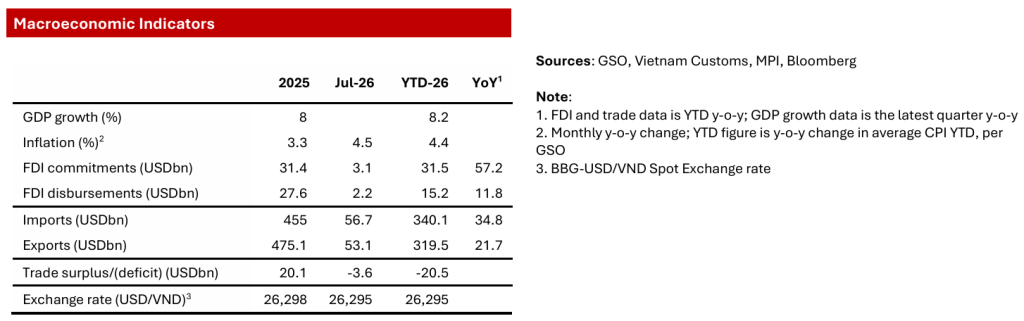
grew by a whopping 35% YoY in7M26, far outpacing export growth of 22% over the same period, and a USD
3.6b trade deficit in the month of July brought the 7M26 trade deficit to USD 20.5b. To put that in context,
Vietnam’s previous record-high annual trade deficit was USD 18b in 2008.
Higher Deposit Rates Support the VN Dong Amid Tighter Liquidity
Trade deficits above 3%/GDP are generally viewed as large and potentially risky, but the USD-VND exchange
rate has barely budged all year and is essentially flat YTD. One reason the VN Dong exchange rate has
remained remarkably stable is that 12-month deposit rates at commercial banks have risen by roughly 150
bps this year to around 8-9% on average, despite inflation remaining very well behaved (CPI inflation eased
from 4.7% YoY in June to 4.5% in July). In short, system-wide credit growth in Vietnam dramatically
outstripped deposit growth over the last two years, including 8.2% credit growth versus 5.8% deposit growth
as of 27-July, pushing Vietnam’s “simple” loan-to-deposit ratio (LDR) up to an estimated 115%, leaving
liquidity in the banking system precariously stretched.
That said, the deposit growth figure is somewhat understated (and the LDR figure overstated) because
Vietnamese banks have been aggressively selling a unique certificate of deposit (CD) type product to retail
savers which has similarities to traditional CDs sold in other countries, but is considered a “valuable paper”,
rather than a deposit in Vietnam. A quick back-of-the-envelope calculation suggests that accounting for
these hybrid CDs as deposits would push deposit growth roughly 1%pts higher and reduce the simple LDR to
around 110%, which is still an uncomfortably high figure.
Local Consumption Remains Resilient
Finally, note that the household consumption figures the Government reported remained remarkably stable
despite a plunge in consumer confidence this year. Confidence was dampened by the high level of mortgage
interest rates, and by the Government’s widening of the tax net in Vietnam to include more household /
cottage industry businesses. Despite these and other factors dampening sentiment real retail sales (stripping
out inflation) actually ticked up from 7.3% YoY in 6M26 to 7.5% in 7M25.