
Off to a Good Start. Strong Leading Indicators and Recovering Consumption
Tet Distortions. Vietnam’s January 2026 economic statistics were skewed by the timing of the Lunar New Year holiday, so we’ll need to wait for the February 2026 data to gain a clearer picture of the country’s economic performance. This year, there were four more official working days in January 2026 compared to January 2025 (last year, the official holiday began at the end of January and extended into early February), but consumption tends to surge and factory production tends to taper off as Tet approaches.
Continuing Trends: Exports and Consumption. Even within these distorted statistics, the economic picture in January 2026 reflects a continuation of trends we observed in 2H25, when Vietnam’s economy was driven by strong exports to the U.S. and domestic consumption remained steady although somewhat subdued. January’s economic indicators demonstrate continued resilient exports to the U.S. alongside strong leading indicators suggesting that these robust exports will continue. Also, consumption rebounded following the devastating floods in November and December which were widely discussed in the local press.
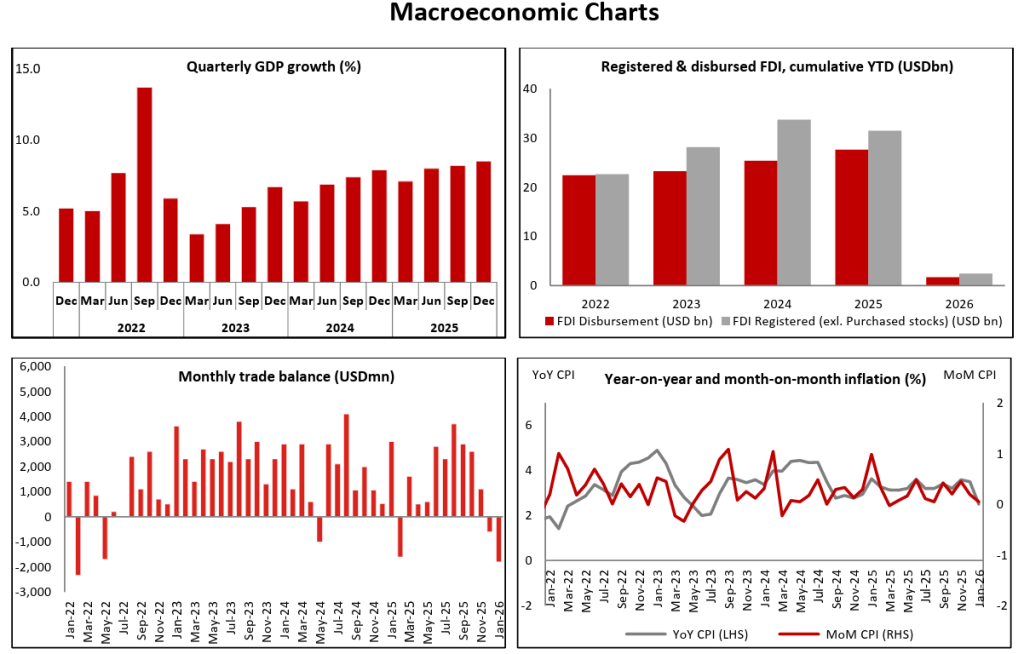
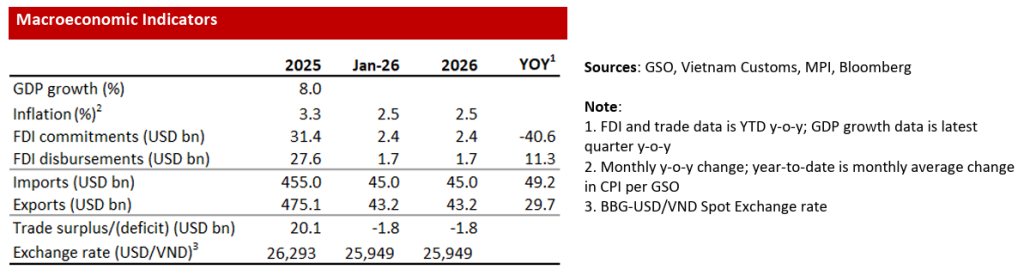
Strong Exports in January. Vietnam’s exports grew 16% year-on-year in January, nearly unchanged from 17% growth in calendar year 2025, and that growth was driven by a 33% surge in exports to the U.S. in 1M26, vs 28% year-on-year growth in 2025. However, manufacturing rose 24% YoY in January 2026 due to the Tet-related distortions discussed above, which have more impact on factory activity than on exports. Vietnam’s manufacturing output was flat month-on-month from December 2025 to January 2026.
Strong Leading Indicators. More importantly, there were strong leading indicators for continued manufacturing strength in January. We previously forecast that goods exports to the U.S. would return to more moderate, double-digit growth this year in our Looking Ahead at 2026 report, but we can already see potential upside to that forecast. Specifically, the new export orders sub-index of Vietnam’s PMI rebounded from 48.4 in December to 51.5 in January, while Vietnam’s imports surged 49% YoY in January, driven by a 70% YoY surge in electronics imports.
PMI Rebounded. Regarding Vietnam’s PMI, the new export orders sub-index reached a 15-month high of 52.4 in November but dipped in December due to the aforementioned floods that devastated large swaths of the country. However, as anticipated, the new export orders figure rebounded in January, which is a strong positive leading indicator for manufacturing prospects. (note: the headline PMI dipped from 53 in December to 52.5 in January due to some statistical anomaly issues that are not important).
Electronics Imports Jumped. The increase in imports of electronics, which jumped nearly 20% month-on-month from December 2025 to January 2026, is an even more critical indicator because it signals that FDI companies are increasing their purchases of production input as their swelling order books will demand these inputs to produce goods destined for export.
Consumption Recovered. Finally, consumption growth fully recovered after the storms in November and December; for context, the year-on-year retail sales growth rate in November–December 2025 was approximately two percentage points lower than in preceding months and in January 2026. Specifically, real retail sales, excluding the impact of inflation, grew by 6.3% year-on-year in January 2026, versus 6.7% for calendar year 2026, but unlike the January 2026 manufacturing figures—which were boosted by the low base set due to the timing of the Tet holiday—these retail figures were actually depressed by the timing of the holiday in 2025. Note also that inflation dipped from 3.5% year-on-year in December to 2.5% in January, thanks to a 10% year-on-year drop in retail petrol prices. This lower inflation has contributed to improving consumer sentiment and, to some extent, supported consumption.